Category: i5
-

i5 Series: From AI-Centric to Orchestration-Native
Many enterprises are now chasing an AI-centric imperative1: copilots in tools, agents in workflows, intelligence embedded everywhere. That’s progress – but it doesn’t solve the hardest problem large organizations face: Some parts may be getting smarter. The overall system is not. Sales, supply, logistics, finance and operations can each have their own AI. Without a coordination…
-
Autonomy Is Not the Breakthrough… Accountability Is
The HBR article “When Supply Chains Become Autonomous” captures an important inflection point: reasoning-capable AI agents can now outperform humans in tightly scoped, simulated supply chain environments. The central question is no longer whether agents can make decisions, but whether organizations can prove – across time, scenarios, and constraints – that those decisions are safe, consistent, and aligned…
-

i5 Context Engineering
i5’s dynamic system design turns context into computation. In i5, context engineering is the practice of embedding dynamic, structured, and evolving information into the simulation engine to generate richer, more adaptive scenarios that respond to real-world shifts. Unlike narrow prompt tuning, i5 context engineering spans: In i5, everything starts from “context.” Traditional systems WAIT for…
-

i5 AI Trust & Transparency (i5 AI-BOM)
Introduction Modern enterprises are increasingly asked not only to adopt AI systems, but also to prove that those systems are safe, transparent, and accountable. Regulators (like the EU AI Act), customers, and procurement teams all expect clear evidence of how AI makes decisions, where its data comes from, and what guardrails keep humans in control. The AI-BOM…
-

The Trust Deficit in Enterprise AI
Enterprises are accelerating their adoption of AI, but face a widening trust deficit. While models grow more powerful, most systems still operate as opaque black boxes – difficult to govern, risky to procure, and vulnerable to regulatory scrutiny. Procurement teams demand documentation, regulators require oversight, and boards insist on explainability. Yet current remedies – explainable AI,…
-

i5: AI is Not the Product
INDUSTRY 5’s system-level approach to decision-making, simulation, and coordination CONTENTS Overview As generative AI continues to reshape expectations across enterprise technology, systems like INDUSTRY 5 (i5) offer a valuable counterpoint – one that reveals how real-time decision-making, simulation, and coordination must be rooted in architectural design, not just surface-level innovation. While many AI-enabled tools emphasize…
-

i5: Simulation-First → Orchestration-at-Scale
INDUSTRY 5’s Four-Phase Delivery Model and Emerging Analyst Frameworks Analyst research in 2025 points to an inflection point in enterprise AI adoption – where incremental pilots give way to orchestration-first strategies that embed governance, interoperability, and adaptability into the operational fabric from day one. INDUSTRY 5’s four-phase orchestration-first model mirrors this trajectory, using synthetic data…
-
i5 Demo: Business Case to Business System …in Minutes | 2025
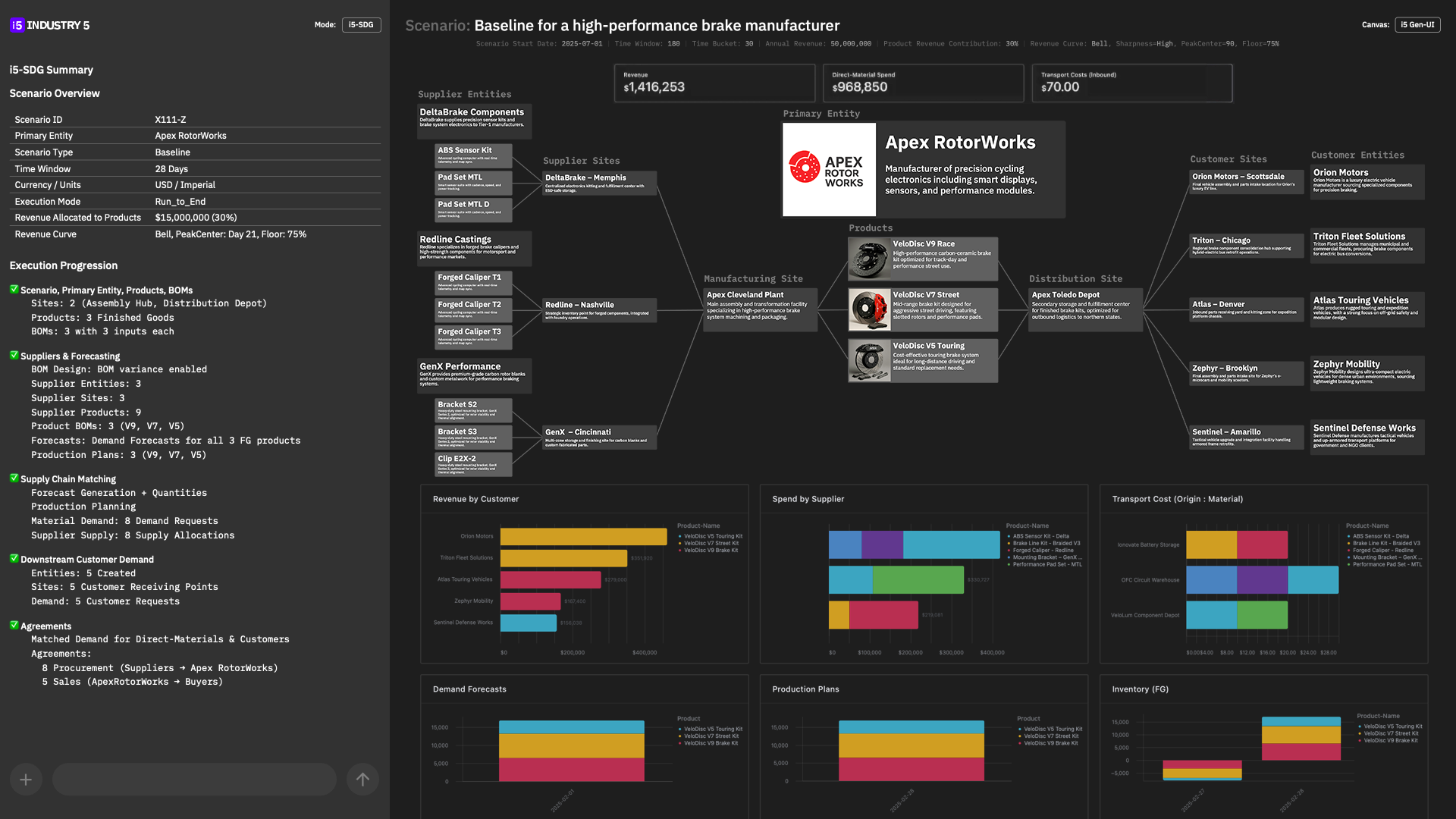
See how i5 builds a working supply chain POC—fast, functional, and friction-free. Hi, I’m Robb Bush, founder of INDUSTRY 5. Let me show you how fast you can spin up a custom POC evaluation of i5, an agentic system for supply chain orchestration. With as little as one input, i5 can generate a full supply…
-
What Enterprise Buyers Really Want from AI in 2025: How i5 Delivers
Constellation Research’s latest article, “What We Learned from Enterprise Tech Buyers in the First Half of 2025,”captures a familiar tension: AI is everywhere in the conversation, but still feels distant in execution. Buyers are interested—but skeptical. The vision is clear, but the path feels opaque. At INDUSTRY 5, we believe this isn’t a signal of doubt.…
-

i5 Value Propositions
Below are results from internal benchmarking and scenario-based validation. INDUSTRY 5 offers more than theoretical innovation. i5 can deliver transformative operational performance. RESPONSIVENESS: Time and effort savings in reacting to unexpected disruptions Traditional systems rely on human intervention and batch updates, delaying response. i5 enables autonomous, real-time reaction, reducing exposure and improving fulfillment. Traditional ERP…