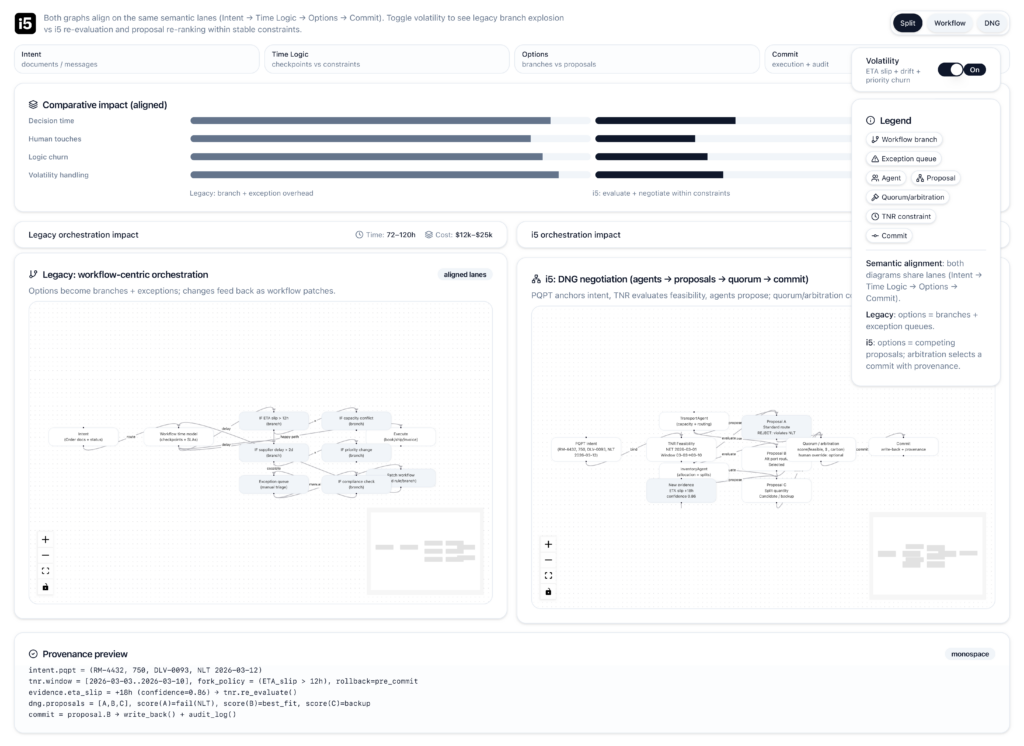
A preview of the foundational models, methods, and constructs from the i5 Design Intelligence Framework
Robb Bush
2026-01-22
Signals
The quiet indicators of a system that is beginning to behave differently.
For most of my career, I have worked on systems that sit at the core of operations—systems that move goods, schedule assets, reconcile interdependencies, and expose the structural constraints that executives would rather assume away. These systems have always been slow to change, not because enterprises lack ambition, but because the software that encodes these operations has been difficult to reshape without destabilizing the business. The cadence of change was set by human development cycles, architectural discipline, and the friction inherent in coordinating large organizations. That constraint defined an era.
Over the last eighteen months, I have watched that constraint weaken. Not abruptly, and not uniformly, but perceptibly. It is visible in the increasingly common anecdotes coming from engineering teams who are adopting agent-assisted development tools. It is visible in the discussions among senior technologists trying to reconcile why components that once required months of engineering now appear as working prototypes in days. It is visible in the commentary of practitioners describing what has been termed the “disappearing middle of software engineering”—the compression between an expression of intent and a functioning implementation.
The underlying technology is not the story. The story is the pattern: the mechanisms that create software are beginning to operate at a pace that breaks the assumptions of the systems built on top of them. When prototypes emerge faster than governance can interpret them, when integration steps collapse from projects into instructions, when code becomes an output of interaction rather than labor, something fundamental in the enterprise computing landscape is shifting. I have seen transitions like this before, but never one that changes the physics of system creation itself.
This shift is reinforced by the rise of agentic development loops. These tools do not simply accelerate coding; they alter the relationship between design intent and executable logic. They allow systems to be explored, revised, and extended through iterative dialogue rather than through extended cycles of specification and implementation. A developer can describe an outcome, and the system can generate the scaffolding required to make it real. These capabilities are still uneven, but their direction is unambiguous: the friction that once governed how quickly enterprise systems could evolve is decreasing.
None of this would matter if enterprise systems were modular, isolated, and loosely coupled. But operational systems—those that run supply chains, manufacturing networks, logistics, infrastructure, and the physical economy—accumulate interdependencies over years. They encode tradeoffs that cannot be revisited casually. They manage commitments that ripple across organizations, partners, regulators, and customers. In these environments, even small deviations can propagate into systemic consequences. When the mechanisms of system creation accelerate, the responsibility for coherence grows heavier, not lighter.
These signals—some subtle, some structural—point toward a simple but significant question: what holds an enterprise system together when the code beneath it becomes easier to change than the operating model it supports? This is not a speculative question. It is the question that separates incremental modernization from the next phase of enterprise system design. And it is the question that has motivated my work on i5: not to chase novelty, but to confront a reality that is arriving faster than most organizations are prepared to acknowledge.
Before introducing that work, we must examine the capabilities that are emerging, the constraints they dissolve, and the opportunities they create. Only then can we understand the logic of a system designed for an environment in which software no longer behaves like a fixed asset, but like a material that can shift, respond, and adapt.
New Capabilities Emerging
The environment in which enterprise systems operate is acquiring properties it did not have before.
Enterprise software has always been constrained by the mechanics of its own creation. Systems grew at the pace developers could produce code, architects could validate assumptions, and organizations could absorb change. This cadence was not merely a function of tooling. It reflected an equilibrium: the rate at which software could safely evolve without outpacing the organizational structures responsible for governing it. That equilibrium held for decades. It is beginning to falter now, not because enterprises desire more speed, but because the tools available to build and modify systems behave differently than the tools that created the systems we are running today.
The first capability that has emerged is a form of computational pliability. Developers increasingly rely on AI-assisted tools that convert descriptions of intent into executable scaffolding. What once required sustained human effort is now produced as an interactive dialog between the builder and the system. The code generated in these sessions is not perfect, nor is it final, but it reduces the distance between “what we want” and “a working approximation.” This compression alters not only the throughput of development but its character; it shifts design from a sequence of tasks into a negotiation with a tool that can propose, revise, and extend ideas in real time.
The second capability is behavioral exploration at scale. Systems can now simulate alternatives, evaluate dependencies, and surface consequences before implementation. Historically, this kind of foresight was limited by the cost of modeling and the scarcity of computational insight built into enterprise applications. Today’s emerging tools can generate variations of logic, test them against synthetic or historical data, and provide a view into the behavioral envelope of a design before it affects production. This capability is uneven across industries, but where it exists, it changes the relationship between planning and execution. Planning becomes iterative rather than episodic; execution becomes the test of validated reasoning, not the discovery of latent flaws.
The third capability is the erosion of friction in integration. Where enterprises once relied on explicitly engineered connectors and brittle ETL pipelines, agent-assisted methods can now generate working integrations from examples, schemas, or observed interactions. These integrations are still supervised, but the human role is shifting from constructing the bridge to verifying that the automatically constructed bridge carries the correct load. The result is not simplification, but acceleration. Interoperability, long the costly side effect of architectural diversity, becomes a problem that can be solved incrementally rather than architecturally.
A fourth capability is emerging inside the systems themselves. Components are beginning to adjust behavior based on operational signals without requiring explicit human intervention. This is not autonomy in the broad sense; it is autonomy in the narrow sense—modules that refine thresholds, re-rank priorities, or adjust decision heuristics in response to local patterns. These adjustments are bounded today, but the direction of development is clear: systems are absorbing the ability to revise small but consequential parts of themselves in response to environmental stimuli. When this capacity spreads across multiple components, the system begins to express behaviors that were not explicitly designed into it.
These capabilities create an environment in which software behaves less like a static artifact and more like a responsive material. Developers no longer write code so much as shape it. Systems no longer reflect a frozen interpretation of business logic but a set of logic that can adapt within boundaries. Integration is no longer exclusively a human act of translation; it becomes a computational task with human oversight. And optimization is no longer periodic; it becomes ambient.
For industries moving physical goods—manufacturing, logistics, supply chain, energy, aerospace—these capabilities land in contexts where operational interdependencies are tightly coupled and consequences propagate quickly. In these environments, the ability to adjust logic, test alternatives, and adapt behavior is undeniably valuable. But it introduces a new tension: systems can change faster than the organization can diagnose the structural implications of those changes.
This environment is not hypothetical. It is emerging. The challenge is that the systems enterprises rely on were not designed for this rate or character of evolution. The capabilities now available create the possibility of continuous adaptation, but they do not solve the problem of coherence. They amplify the opportunity, but they also amplify the risk. They reduce development friction, but they increase the cognitive load on the enterprise. They move the bottleneck from implementation to understanding.
The question that follows is unavoidable: If systems acquire the ability to adjust themselves at the margins, what mechanisms ensure they do so in ways that strengthen the enterprise rather than fragment it? The logic of the next section begins there.
What Becomes Unnecessary
The methods that once stabilized enterprise systems lose relevance as the environment around them accelerates.
Enterprise technology has always relied on the idea that software changes slowly. That assumption justified the mechanisms that emerged to control risk: stage gates, approval cycles, architectural reviews, integration programs, regression test suites, and governance processes that validated behavior only after the system had already evolved. These mechanisms did not exist because enterprises were cautious; they existed because systems were brittle. The cost of error was high, the pace of revision was slow, and the safest way to avoid destabilizing the business was to prevent change until it could be fully understood.
As the capabilities described in the previous section take hold, the value of these mechanisms begins to erode—not because they cease to work, but because the environment in which they were effective no longer exists. The traditional software development lifecycle assumes a deliberate choreography: requirements defined upfront, designs reviewed before implementation, integration tested at the boundaries, and deployment as an event. This sequence presupposes that each phase captures something stable enough to be examined in isolation. When development cycles compress and systems adjust behavior incrementally, that stability cannot be guaranteed. The SDLC becomes a form of friction that no longer produces proportional safety.
Architecture faces a similar tension. Architecture is effective when system boundaries remain stable over time and when the interdependencies among components can be described and reasoned about using static abstractions. But as systems begin to refine themselves at the margins and as developers rely on increasingly generative tools to reshape logic in response to operational feedback, architecture loses its ability to reflect the working system. The diagrams become historical artifacts rather than operational guides. The longer the rate of change outpaces the rate at which architecture can be validated and redrawn, the less architecture stabilizes the system and the more it documents a system that no longer exists.
Integration programs are also strained. Historically, enterprises accepted that connecting systems required multi-year initiatives, custom interfaces, and a negotiation of semantics that could survive organizational change. These programs were expensive, but they were built on a premise that held true: once integrated, systems would remain structurally consistent for years. As integration generation becomes increasingly automated and as systems begin to produce and consume new forms of logic on demand, the cost structure and time horizon of traditional integration projects become liabilities. They are too slow to capture the dynamics of the systems they are meant to connect.
Governance is also affected. Traditional governance assumes that compliance can be audited retrospectively—that actions can be traced, decisions explained, and violations rectified. As systems begin to adjust behavior autonomously in small but significant ways, retrospective governance loses its grip. By the time governance detects a deviation, the system may have already refined the logic that produced it. Manual oversight cannot scale to systems that mutate more quickly than they can be examined. Governance mechanisms that rely on checkpoints, committees, or documentation become mismatched to the frequency and granularity of change.
Even the logic of platform consolidation—the belief that enterprises can buy coherence through unification—begins to weaken. Consolidation reduces the number of systems, but it does not reduce the complexity of the world those systems must represent. It merely hides the complexity behind a single vendor’s abstractions. When the external environment changes faster than those abstractions can be updated, coherence disappears anyway. In an era where adaptability must occur at the level of design rather than at the level of products, consolidation becomes a slower version of the same underlying problem.
None of these mechanisms disappear entirely. They remain useful in domains where change is slow, variance is low, and systems behave predictably. But in environments where software becomes easier to modify, easier to generate, and easier to integrate, the central justification for these mechanisms weakens. The enterprise continues to rely on them out of habit, but the gap between their intended purpose and their actual effect widens.
The point is not that these constructs are obsolete. It is that they were built for a world in which the rate of change was dominated by human effort and constrained by the difficulty of modifying software. As that constraint weakens, the mechanisms built on top of it weaken as well. We begin to see a mismatch between the tempo of system evolution and the structures meant to govern it. And whenever tempo diverges from structure, coherence is the first casualty.
This opens a new question: If the old mechanisms lose their stabilizing power, what replaces them?
Before answering that directly, we must understand what becomes newly possible when the constraints that shaped the last generation of enterprise systems begin to lift.
What Becomes Newly Possible
The dissolution of old constraints creates opportunities that existing systems were never designed to exploit.
When the mechanisms of software creation accelerate, enterprises do not simply gain efficiency; they gain access to forms of adaptation that were previously unreachable. The constraints that shaped the last generation of operational systems—rigid architectures, fixed process boundaries, manually curated integrations—begin to loosen. As these constraints weaken, the enterprise gains an opportunity that has been structurally unavailable: the ability to revise the behavior of its systems at the same tempo that the environment revises the conditions under which those systems must operate.
The first possibility that emerges is continuous operational alignment. Historically, alignment across functions—planning, procurement, logistics, manufacturing, finance—depended on slow reconciliation cycles. Each function optimized within its own boundary because the cost of coordinating across boundaries was high. When system components can be adjusted rapidly, and when their interactions can be simulated before execution, alignment becomes a matter of design rather than negotiation. Functions can converge on decisions that respect shared constraints because the system can surface those constraints in real time, rather than after the fact. Alignment becomes the default posture, not the occasional achievement.
The second possibility is adaptive decision-making at the system level. Traditional enterprise systems are reactive. They trigger workflows when thresholds are breached or when events occur, but they rarely anticipate the effects of a decision across time and across functions. As systems acquire the ability to evaluate alternatives through simulation and adjust decision parameters automatically, they begin to act with a form of operational foresight. They can test a routing choice against supply variability, or a production adjustment against demand volatility, or a schedule change against financial exposure, without requiring human calculation. This does not replace human judgment; it removes the mechanical burden that once constrained it.
A third possibility emerges from the reduction in integration friction: rapid formation of coordinated behaviors across heterogeneous systems. Enterprises are collections of systems built over decades, each reflecting the capabilities and limitations of its time. Integration has always been a bottleneck because it required reconciling these differences manually. When integrations can be synthesized from schemas or derived from observed interactions, the system gains a capacity for coordination that does not depend on architectural unity. Components that were never designed to collaborate can participate in shared decision processes without the overhead of large transformation programs. The enterprise gains coherence without requiring consolidation.
A fourth possibility involves the responsible deployment of autonomy. Autonomy has historically been constrained by the difficulty of ensuring that partially independent systems would behave consistently with enterprise objectives. As components gain the ability to test their own logic, evaluate alternatives, and expose the reasoning behind proposed actions, autonomy becomes governable. The enterprise can delegate bounded decision-making to components without losing visibility into why those decisions were made or how they affect other commitments. Autonomy becomes a controlled instrument rather than a source of operational risk.
These possibilities converge into something more significant than incremental improvement. They point toward an enterprise system that behaves less like a collection of rigid applications and more like a coordinated, adaptive organism—capable of sensing changes, evaluating options, and aligning behavior without requiring every adjustment to pass through manual intervention. This is not a prediction of fully autonomous enterprises. It is a recognition that the preconditions for adaptive behavior are accumulating faster than the structures available to direct them.
For industries engaged in the movement of physical goods, these possibilities translate into concrete opportunities. Supply chains can renegotiate constraints dynamically. Manufacturing systems can adjust schedules without cascading failures. Logistics networks can optimize capacity in response to emergent conditions. Maintenance systems can coordinate with planning systems rather than reacting to them. The complexity that once overwhelmed human decision processes becomes an asset when the system can reason across it.
But these possibilities introduce a new design challenge. As the system becomes more capable of adjusting itself, the burden of ensuring that these adjustments do not conflict, drift, or destabilize the enterprise grows proportionally. The opportunities become real only if the enterprise can guarantee coherence across components that adapt at different times and for different reasons. The potential benefits rise alongside the potential for fragmentation.
This establishes the central tension: the environment is granting enterprises the ability to move faster than their existing structures can safely accommodate. The next section addresses the structural consequence of that tension—the gap that must be filled before any of these possibilities can be pursued with confidence.
The Gap: When Implementation Outruns Architecture
The system becomes capable of changing faster than the structures designed to keep it coherent.
The capabilities now emerging—generative development, behavioral exploration, rapid integration synthesis, and bounded autonomy—introduce a structural imbalance inside the enterprise. The implementation layer gains the ability to evolve at a tempo that the architectural and governance layers were never designed to match. This imbalance is not theoretical. It is observable in the divergence between how quickly a system can be modified and how slowly an organization can understand, validate, and govern the implications of that modification. When change accelerates asymmetrically, the stabilizing mechanisms that once preserved coherence become insufficient.
Architecture is the first structure to feel the strain. Architectural models assume that system boundaries shift infrequently and that interactions among components remain understandable through static representations. As components begin to adjust themselves in small increments, architecture becomes a retrospective description rather than an operational guide. It loses its predictive power. It can no longer guarantee that the system described in its diagrams resembles the system in production. When implementation becomes fluid, architecture no longer anchors the system; it records its drift.
Governance suffers a parallel fate. Traditional governance relies on checkpoints and approvals that assume discrete change events. It presumes that behavior can be examined after implementation and corrected through human intervention. But as systems begin to adapt continuously—through regenerated logic, algorithmic refinements, or autonomous adjustments—the unit of change becomes too small and too frequent to be captured by retrospective governance. By the time a deviation is observed, the system may have already iterated past the conditions that produced it. Governance that operates after the fact becomes governance in name only.
Integration inherits the same tension. An enterprise of any meaningful scale is a network of interdependent systems, each optimized within its own functional boundary. Integration projects assume that the interfaces among these systems are stable enough to justify the cost of connecting them. But when components can revise behaviors or schemas automatically, the stability of those interfaces cannot be assumed. The integration layer becomes the weakest link: a brittle surface between systems whose internal logic evolves more quickly than the connections that bind them. Integration becomes a point of failure rather than a point of coherence.
These failures have a common root. They assume a world in which implementation is slow, deliberate, and bounded by human effort. They were built to tame the volatility of human-driven change, not the volatility of systems capable of adjusting themselves. When the source of variability moves from people to software, the structures that once stabilized the enterprise cease to operate at the correct temporal resolution. They drift behind the system they were meant to control.
This mismatch creates a gap that enterprises can neither ignore nor fill with existing practices. The gap is not about speed; it is about alignment under conditions of continuous change. As systems gain the ability to alter their behavior, the enterprise must ensure that these alterations do not conflict with other operational commitments, violate constraints, or dilute the integrity of cross-functional decisions. Without a mechanism to coordinate change at the system level, each local adaptation becomes a potential source of global inconsistency.
The gravity of the gap becomes clearest in industries where operational interdependencies are tight. In manufacturing, a small adjustment in production sequencing can propagate through materials planning, logistics, quality control, and financial exposure. In supply chains, a local optimization of transportation can violate capacity assumptions in upstream planning. In energy systems, a minor shift in dispatch logic can destabilize cost or compliance regimes. The more capable systems become, the more dangerous uncoordinated adaptation becomes. The benefits of autonomy and acceleration are real, but so are the consequences of misalignment.
This is the moment where many organizations retreat into consolidation or platform standardization. The instinct is understandable: if coherence is threatened by distributed change, then coherence must be purchased through unification. But consolidation does not solve the underlying problem; it only relocates it. A consolidated platform may temporarily simplify interfaces, but it cannot change the fact that the environment demands rapid adaptation. As soon as the platform must evolve to meet those demands, the same tension reappears—only now under the control of a single vendor whose incentives may not align with the enterprise’s needs.
The structural gap remains: the enterprise needs a way to govern the behavior of a system that is capable of evolving faster than the models used to describe it. The mechanisms that once held the system together cannot operate at the speed or granularity required. The pace of implementation has outpaced the pace of understanding.
The implications of this gap are not optional. They define the conditions under which enterprise systems must now operate. If the enterprise cannot guarantee coherence in the face of continuous adaptation, it will either slow the system—losing the benefits of emerging capabilities—or accept drift and inconsistency—accumulating risks it cannot manage. Neither option is tenable.
A new structure is required: one that sits above implementation, governs behavior rather than code, coordinates decisions rather than components, and retains coherence even as the underlying logic evolves. The next section introduces that structure.
The Bridge: Introducing the i5 System
A design intelligence for systems that must remain coherent as their implementation becomes fluid.
The gap described in the previous section is not a temporary imbalance. It is the structural condition that emerges whenever the mechanisms for creating and modifying software become faster, more generative, and more autonomous than the mechanisms designed to govern them. Once this condition appears, it does not reverse. No organization can return to the slower, more deliberate environment in which traditional architectural and governance structures were sufficient. The enterprise must either control the consequences of accelerated change or become controlled by them.
The i5 System exists to address this condition. It is not a platform, a product, or a replacement for the systems enterprises use today. It is a design intelligence—a formal system of logic that governs how an enterprise system behaves when the underlying implementation is capable of evolving continuously. It provides the layer of stability that architecture can no longer supply and the layer of alignment that governance can no longer enforce. It sits above the implementation, not inside it, and functions as the coordinating logic through which the enterprise defines, constrains, and validates the behavior of a system that is no longer static.
The essential function of i5 is straightforward: it formalizes the rules by which a system adapts. It defines the commitments the system must honor across functions. It describes the constraints within which decisions must remain. It provides a method for resolving competing objectives and a structure through which the system evaluates the consequences of potential adaptations. It ensures that decisions made by autonomous components remain aligned with the enterprise’s intent, even when those components evolve independently. It is not concerned with how components are built; it is concerned with how they behave in relation to each other.
The logic of i5 is expressed through constructs that encode system behavior at a level higher than code or architecture. These constructs operate at the scale of commitments, constraints, temporal dependencies, negotiation among components, and validation of proposed changes. They represent relationships that architecture cannot capture because architecture describes structure, not behavior; they represent judgments that governance cannot enforce because governance operates after the fact. i5 operates at the point where decisions are made, not at the point where they are audited.
This design intelligence enables a different mode of system building. Instead of constructing applications that embed business logic directly into code, enterprises use i5 to define the logic that governs how business logic is generated, evaluated, combined, and constrained. Implementation becomes the output of design, not the container of it. Systems become adaptable because their behavior is defined at a level that does not require rewriting code to revise logic. Coherence becomes durable because the relationships among components are defined explicitly and validated continuously.
Importantly, i5 does not assume that enterprises will rebuild their systems or abandon their existing investments. It is a layer that overlays the current IT landscape. The systems an enterprise already operates—ERP, manufacturing execution, logistics platforms, planning tools, optimization engines—continue to perform their roles. i5 does not replace them; it coordinates them. It provides a common language through which these systems participate in shared decisions, resolve conflicts, and maintain alignment even when they evolve independently.
This positioning distinguishes i5 from existing approaches. Workflow platforms coordinate tasks, not decisions. Integration platforms connect endpoints, not behaviors. Optimization engines improve subproblems, not the system as a whole. AI platforms generate models, not commitments. Agent frameworks produce local autonomy without systemic alignment. ERP suites centralize data and processes but cannot adapt their behavioral logic at the tempo demanded by modern operations. Each solves a problem of its era; none addresses the problem that emerges when implementation becomes more fluid than the structures meant to govern it.
The i5 System addresses that problem directly. It establishes a governing logic for a class of systems that previous generations of enterprise technology could not conceive: systems that change continually, coordinate autonomously, and participate in decisions that span functions, constraints, and time horizons. It provides the formal structure through which the enterprise asserts control over this new environment—not by slowing it down, but by giving it shape.
Introducing i5 at this point in the argument is not a proposal. It is the consequence of the preceding logic. If systems are going to evolve faster than architecture, then a new layer must govern the system. If autonomy is going to increase, then a new structure must align it. If integration is going to accelerate, then a new method must ensure it does not fragment the enterprise. i5 is that structure: the design intelligence that stabilizes a system whose implementation can no longer serve as its own anchor.
The next section describes how enterprises adopt i5 without disruption—how the design intelligence overlays existing systems, introduces coherence incrementally, and allows organizations to navigate the transition from slow-evolving systems to adaptive ones without sacrificing control.
Transition: How i5 Coexists With and Elevates Existing Systems
The enterprise must move into a new mode of system behavior without discarding the systems that already run it.
Enterprises do not have the option to rebuild their operational systems from scratch. These systems encode decades of decisions, constraints, and contractual obligations. They represent the accumulated logic of how a business functions—not as an abstraction, but as the concrete foundation upon which revenue, compliance, and customer commitments depend. Any approach that requires replacing them, re-platforming them, or re-architecting them is not only impractical; it is structurally incompatible with the responsibilities of operating a real enterprise. The transition to adaptive systems must therefore occur in a way that respects the continuity of the existing landscape.
The i5 System is designed for this constraint. It does not require enterprises to alter or abandon their current systems. It overlays them. It introduces a governing logic that operates above implementation, allowing existing applications, workflows, agents, and platforms to participate in coordinated decisions without being rewritten. This is not a metaphorical layering; it is a structural one. i5 provides the decision logic, commitment structures, and behavioral constraints that current systems lack, while leaving their internal mechanics unchanged.
This approach resolves the central tension of the transition: the enterprise must adopt new capabilities without destabilizing the systems that provide operational reliability. With i5, the transition does not begin with code. It begins with design. Enterprises start by describing the commitments their systems must honor, the constraints that govern their operations, and the relationships among functions that must remain stable even as implementation changes. These descriptions are not architectural diagrams or process maps. They are behavioral definitions—formal structures that specify how decisions should be made, justified, validated, and aligned across the system.
Once these structures exist, i5 uses them to generate the logic that coordinates existing systems. It does not reach inside those systems; it orchestrates their interactions. It evaluates the consequences of alternatives, identifies conflicts, and determines when a proposed action violates commitments or temporal constraints. It surfaces these conditions through interfaces that existing systems can consume without modification. In effect, i5 turns the current landscape into a coordinated environment without requiring the underlying systems to behave differently.
This coexistence is the critical differentiator between i5 and traditional transformation models. Transformation efforts attempt to replace complexity with standardization. i5 accepts complexity as inherent and instead imposes coherence through design. Transformation efforts attempt to centralize decision-making in monolithic platforms. i5 distributes decision-making across the systems that already perform operational roles, but binds their behavior through shared logic. Transformation efforts attempt to slow the rate of change to maintain stability. i5 accepts change as a constant and ensures stability through constraints that operate at the same tempo as the system.
Because i5 governs behavior rather than implementation, adoption can occur in phases. Enterprises can begin with a single domain—a supply chain segment, a logistics operation, a production scheduling problem—and introduce i5 as the coordinating logic for that domain. As confidence grows, the scope expands. i5 does not require global adoption to provide value; it provides value wherever coherence matters and where systems must reconcile conflicting objectives. This incremental approach allows enterprises to pilot adaptive behavior without jeopardizing core operations.
Over time, as more domains adopt i5, the system begins to operate as a unified whole. Decisions made in one function automatically respect commitments made in another. Adaptations in one component are validated against system-level constraints before they propagate. Autonomy becomes predictable. Integration becomes a behavioral alignment problem rather than an engineering problem. The enterprise gains the benefits of fluid adaptation without the risks of ungoverned change.
This transition model also avoids the structural risks associated with vendor dependency. Because i5 produces design logic rather than delivering a hosted platform, enterprises retain ownership of their systems. The logic that governs behavior is licensed intellectual property, not a black-box runtime controlled by a provider. This preserves enterprise sovereignty, reduces lock-in, and allows organizations to adapt the system using their own tools, teams, and infrastructure. It gives enterprises the freedom to innovate at the edges while stabilizing the core.
The outcome of this coexistence is a system that behaves differently from the one it replaces, even though many of its components remain the same. It becomes adaptive without being fragile, coordinated without being centralized, governed without being constrained. It gains the ability to evolve as quickly as the environment demands, without losing the commitments that define its responsibilities.
This model sets the stage for the next requirement in the narrative: if i5 overlays the enterprise and governs its adaptive behavior, what exactly does it produce? What artifacts make this governing logic concrete, testable, and operational? The answer is not theoretical. It is expressed through the outputs of i5 Design Intelligence—the structures that prove the paradigm is real.
The next section will introduce those artifacts.
What i5 Design Intelligence Generates
Evidence that the governing logic is real, operational, and available today.
The value of a design intelligence cannot be asserted; it must be demonstrated. Enterprises do not adopt new system paradigms because they are elegant or forward-looking. They adopt them when the logic produces artifacts that are more complete, more coherent, and more operationally useful than the artifacts produced by the current approach. The legitimacy of i5 Design Intelligence rests on this standard. It must generate structures that expose intent unambiguously, capture constraints precisely, express system-level commitments explicitly, and validate decisions before they propagate. The output must be concrete enough to guide implementation and stable enough to anchor a system that is otherwise fluid.
Transaction Compression
The first class of artifacts i5 generates is a compressed representation of operational intent. Traditional requirements documents describe what a system should do, but they do so in prose—ambiguous, negotiable, and often contradictory. i5 produces a formal structure that expresses intent in terms the system can reason about. This is not a catalog of functions; it is a distillation of priorities, obligations, and tradeoffs encoded in a form that can be evaluated against scenarios. It defines what the enterprise must preserve when conditions change.
Figure 8.1 — Intent Compression Model (Executable Representation)
# i5-IntentCompression
# Generated structure (tool-agnostic), representing operational intent
# distilled from stakeholder objectives, constraints, and obligations.
IntentModel:
  Version: 1.0
  Domain: "Order Fulfillment - North America"
  PriorityWeights:
    service_level: 0.45
    cost_efficiency: 0.30
    capacity_protection: 0.25
  HardConstraints:
    - name: "DeliveryWindow"
      rule: "shipment.delivery_date <= customer.commit_date"
    - name: "RegulatoryLimit"
      rule: "hazmat.volume_per_truck <= legal.max_volume"
  SoftConstraints:
    - name: "MarginProtection"
      rule: "order.margin >= target.margin_floor"
      tolerance: 0.02
    - name: "ScheduleFlex"
      rule: "production.shift_load <= shift.capacity"
      tolerance: 0.10
  TradeoffLogic:
    - if: "service_level_conflict"
      then: "override_cost_efficiency"
      rationale: "service commitments dominate financial optimization"
    - if: "capacity_conflict"
      then: "trigger_negotiation('manufacturing_schedule')"
  OutcomeTargets:
    on_time_delivery: ">= 97%"
    cost_per_unit: "<= 3.20"
    capacity_variance: "< 5%"
  Notes:
    - "This compact representation becomes the governing reference for
       all downstream feasibility analysis, negotiation surfaces,
       and scenario validation."
This artifact shows i5 compressing multi-dimensional operational intent into a formal, machine-interpretable structure. It is neither a requirements doc nor a KPI list — it is executable logic that downstream components (temporal reasoning, negotiation, validation) can reason over. This is the foundation for all i5 behavior.
Temporal Representation
The second class of artifacts is a temporal feasibility map. Enterprise operations unfold across time, and decisions that appear optimal in the present can violate commitments in the future. i5 models these temporal relationships explicitly, producing structures that show which actions are feasible, which create conflicts, and which introduce risks that may not be visible at the local level. These maps allow the system to test alternatives before executing them. They give the enterprise foresight.
Figure 8.3 — Temporal Feasibility Map (Generated Representation)
# i5-TemporalFeasibilitySurface
# Generated structure expressing causal and temporal constraints
# derived from the IntentModel and operational data.
TemporalModel:
  Horizon: "72h"
  TimeUnit: "1h"
  Anchors:
    - name: "Cutoff_Shipping"
      timestamp: "order.commit_date - 6h"
    - name: "Production_Start"
      timestamp: "production.window_start"
    - name: "Dock_Capacity_Reset"
      timestamp: "daily 00:00"
  Dependencies:
    - action: "schedule_production"
      requires:
        - "materials.confirmed"
        - "capacity.available"
        - "shift.alignment in ['A','B']"
    - action: "dispatch_shipment"
      blocked_by:
        - "pending_quality_checks"
        - "production_delay > 2h"
  FeasibilityWindows:
    - action: "expedite_order"
      window:
        start: "now"
        end: "Cutoff_Shipping"
      risk_factors:
        - name: "capacity_compression"
          threshold: ">= 0.85"
          effect: "reduce_window_by 1h"
    - action: "reschedule_batch"
      window:
        start: "Production_Start - 8h"
        end:   "Production_Start + 2h"
      conditional_extensions:
        - if: "demand_spike >= 10%"
          then: "extend_end_by 3h"
  TemporalConflicts:
    - conflict: "dock_overload"
      condition: "arrivals_per_hour > dock.capacity"
      mitigation:
        - "shift_arrival_time +1h"
        - "reroute_to_secondary_dock"
  RippleEffects:
    - trigger: "production_delay"
      magnitude: "delay.duration"
      cascades:
        - "shipment.slip_by delay.duration"
        - "carrier.reassignment if slip_by > 4h"
This temporal surface shows how i5 translates intent and constraints into a live causal model that understands feasible windows, dependencies, conflicts, and ripple effects — allowing the system to validate or reject proposed actions before they occur. This is something no workflow engine, agent framework, or planning tool can produce without extensive manual modeling.
Dynamic Negotiation
A third class of artifacts describes negotiation structures across components. Enterprise systems are collections of agents, each responsible for localized decisions: inventory allocation, routing optimization, capacity planning, production sequencing, financial exposure management. These agents operate within narrow contexts, but their actions propagate system-wide. i5 generates structures that allow these agents to negotiate constraints, resolve conflicts, and produce decisions that remain coherent across the enterprise. These negotiation surfaces are not abstractions; they are formal representations of the tradeoff landscape.
Figure 8.4 — Negotiation Surface
# i5-NegotiationSurface
# Defines how components propose, evaluate, and reconcile decisions.
# Structured for multi-agent alignment across functions.
NegotiationSurface:
  Domain: "Order Fulfillment - NA"
  Participants:
    - component: "InventoryAllocator"
      objectives:
        - minimize_stockout_risk
        - preserve_high-margin_units
      constraints:
        - "inventory.available >= demand.requested"
        - "safety_stock >= threshold"
    - component: "ProductionScheduler"
      objectives:
        - maximize_throughput
        - minimize_changeover_cost
      constraints:
        - "shift.capacity >= plan.required_capacity"
        - "machine.state == 'available'"
    - component: "TransportationOptimizer"
      objectives:
        - minimize_rate_cost
        - reduce_lane_volatility
      constraints:
        - "carrier.capacity >= load.volume"
        - "hazmat_rules == compliant"
  SharedConstraints:
    - name: "DeliveryCommitment"
      rule: "shipment.arrival <= customer.commit_date"
    - name: "MarginFloor"
      rule: "order.margin >= target.margin_floor"
  ProposalSchema:
    fields:
      - name: "action"
        type: string
      - name: "cost_impact"
        type: float
      - name: "service_impact"
        type: float
      - name: "capacity_impact"
        type: float
      - name: "feasibility_rating"
        type: float
  NegotiationProtocol:
    steps:
      - propose:
          participants: ["InventoryAllocator", "ProductionScheduler"]
          rule: "generate action alternatives respecting SharedConstraints"
      - evaluate:
          participants: ["TransportationOptimizer"]
          rule: "score proposals against lane capacity + rate structures"
      - reconcile:
          logic:
            - if: "proposal.service_impact < 0"
              then: "increase weight of ProductionScheduler"
            - if: "proposal.cost_impact > threshold"
              then: "reject or request revision"
      - finalize:
          merge_rule: "select proposal maximizing system-level intent weights"
          output: "aligned_decision_object"
  Outcome:
    emits: "DecisionPackage"
    guarantees:
      - "no violation of SharedConstraints"
      - "transparent tradeoff rationale"
      - "alignment with IntentModel priority weights"
This negotiation surface shows how i5 structures multi-component decision-making. Instead of components optimizing locally, they participate in a shared decision protocol with explicit constraints, tradeoffs, and reconciliation logic — producing aligned, explainable system-level outcomes.
Smarter SLAs
Fourth, i5 produces system-level commitments—explicit representations of the obligations that must be honored regardless of local optimization. These commitments serve as the enterprise’s backbone. They define what cannot be violated without destabilizing operations. They encode tolerances, invariants, and cross-functional agreements in a machine-interpretable form. Traditional systems embed these commitments implicitly in code or workflows, where they decay over time. i5 elevates them to first-class structures.
Figure 8.5 — System-Level Commitment Schema
# i5-CommitmentSchema
# Generated by i5 to formalize enterprise-wide obligations
# across functions (planning, production, logistics, finance).
CommitmentSchema:
  Domain: "NA Fulfillment"
  Commitments:
    - name: "OnTimeDelivery"
      type: "hard"
      obligation:
        rule: "shipment.arrival <= customer.commit_date"
      scope:
        applies_to: ["TransportationOptimizer", "ProductionScheduler"]
      exceptions:
        - condition: "weather_disruption == TRUE"
          require: "invoke_contingency_plan"
      guarantee:
        - "all decisions validate against DeliveryCommitment"
    - name: "MarginIntegrity"
      type: "soft"
      obligation:
        rule: "order.margin >= target.margin_floor"
      tolerance: 0.02
      scope:
        applies_to: ["InventoryAllocator", "OrderPromiser"]
      adjustment_logic:
        - if: "demand_spike >= 12%"
          then: "relax margin_floor by 0.5%"
      guarantee:
        - "negotiation surfaces must represent cost impacts explicitly"
    - name: "CapacityCoherence"
      type: "hard"
      obligation:
        rule: "production.plan_volume <= shift.capacity"
      scope:
        applies_to: ["ProductionScheduler"]
      dependencies:
        - "machine.availability"
        - "maintenance.schedule"
      violation_handling:
        - "reject proposal"
        - "trigger_reallocation('InventoryAllocator')"
    - name: "DockSynchrony"
      type: "timing"
      obligation:
        rule: "arrival_flow_rate <= dock.capacity_per_hour"
      scope:
        applies_to: ["TransportationOptimizer"]
      ripple_effects:
        - "if dock_overload: shift_arrivals +1h"
        - "notify ProductionScheduler of downstream slip"
      guarantee:
        - "temporal feasibility must incorporate dock model"
  Invariants:
    - "no action may violate two hard commitments simultaneously"
    - "system-level commitments supersede local optimizations"
  DependencyGraph:
    edges:
      - from: "OnTimeDelivery"
        to:   "CapacityCoherence"
        type: "temporal"
      - from: "CapacityCoherence"
        to:   "MarginIntegrity"
        type: "resource"
      - from: "DockSynchrony"
        to:   "OnTimeDelivery"
        type: "logistical"
  Notes:
    - "Commitments are evaluated before, during, and after negotiation cycles"
    - "Commitments act as global constraints in scenario validation"
i5’s commitment schema encodes the cross-functional obligations that govern the enterprise. These commitments become the system’s non-negotiable backbone—stabilizing behavior even as individual components adapt or iterate autonomously.
Scenario Simulation
Fifth, i5 generates scenario-based validation harnesses. In environments where systems evolve continuously, correctness must be proven before actions are taken. i5 constructs evaluative harnesses that test proposed decisions against synthetic and historical scenarios. These harnesses expose conflicts, detect constraint violations, and surface second-order effects before they materialize in production. They transform operational risk from a consequence of change into an input to decision-making.
Figure 8.6 — Scenario Validation Harness
# i5-ScenarioValidationHarness
# Validates a proposed action BEFORE execution.
# Combines:
#  - IntentModel
#  - TemporalFeasibilitySurface
#  - NegotiationSurface
#  - CommitmentSchema
ScenarioHarness:
  Metadata:
    scenario_id: "NA-fulfillment-472"
    proposed_action: "dispatch_shipment_23817"
    timestamp_generated: "2026-01-05T09:14Z"
  Inputs:
    ProposedAction:
      action: "dispatch_shipment"
      order_id: "23817"
      departure_time: "2026-01-06T04:00Z"
      assigned_carrier: "Carrier_5"
      volume: 28
      lane: "LAX-CHI"
  ValidationStages:
    - stage: "CommitmentCheck"
      evaluate:
        - rule: "OnTimeDelivery"
          result: "PASS"
        - rule: "MarginIntegrity"
          result: "PASS"
        - rule: "DockSynchrony"
          result: "FAIL"
          reason: "arrival_flow_rate exceeds dock.capacity_per_hour"
      outcome: "HALT_IF_FAIL"
    - stage: "TemporalFeasibility"
      evaluate:
        - rule: "departure_time <= Cutoff_Shipping"
          result: "PASS"
        - rule: "carrier.capacity >= volume"
          result: "PASS"
        - rule: "ripple: production_delay cascade"
          result: "NEUTRAL"   # no triggering events
      window_analysis:
        feasible: true
        risk_score: 0.18
      outcome: "CONTINUE"
    - stage: "NegotiationSurface"
      evaluate:
        participants:
          - "TransportationOptimizer"
          - "ProductionScheduler"
        inputs:
          service_impact: 0
          cost_impact: +0.12
          capacity_impact: -0.05
        reconciliation:
          - if: "cost_impact > 0.10"
            then: "request_revision"
            result: "TRIGGERED"
      outcome: "REVISION_REQUESTED"
    - stage: "RippleEffectAssessment"
      forecast:
        - ripple: "delivery_slip"
          magnitude: "0h"
          impact: "none"
        - ripple: "dock_shift"
          magnitude: "+1h"
          impact: "moderate"
      outcome: "CONTINUE"
  FinalDecision:
    status: "REJECTED"
    reason: "Violation of DockSynchrony commitment + cost deviation"
    required_adjustments:
      - "shift_arrival_time +1h"
      - "select alternate carrier or lane"
      - "re-run negotiation with updated proposal"
  AuditTrail:
    explanation:
      summary: "Action rejected based on system-level commitments and negotiation logic."
      details:
        - "DockSynchrony conflict detected at Stage 1."
        - "Cost impact beyond threshold triggered protocol revision."
        - "Other constraints satisfied; proposal can be resubmitted once corrected."
i5’s Scenario Validation Harness evaluates proposed actions before they propagate — checking commitments, feasibility windows, negotiation logic, and downstream ripple effects. This ensures system-wide coherence and safety even when components adapt autonomously or generate new logic.
Explainability and Trust
Sixth, i5 outputs explainability narratives—structured descriptions of why a particular decision was made, what alternatives were considered, how constraints shaped the final outcome, and what commitments the decision preserves. These narratives provide accountability in environments where autonomy is increasing. They allow humans to interrogate the system’s reasoning using the same constructs the system uses to govern itself. They transform explainability from a debugging artifact into a governance asset.
Figure 8.9 — Decision Package Structure
# i5-DecisionPackage
# Emitted when a decision has passed full evaluation and is ready for execution.
# Combines: IntentModel + TemporalSurface + Commitments + NegotiationSurface + ScenarioHarness output.
DecisionPackage:
  metadata:
    decision_id: "DP-23817"
    generated_at: "2026-01-05T09:16Z"
    originating_system: "FulfillmentOrchestrator"
    decision_type: "shipment_dispatch"
  decision:
    action: "dispatch_shipment"
    order_id: "23817"
    scheduled_departure: "2026-01-06T04:00Z"
    assigned_carrier: "Carrier_5"
    lane: "LAX-CHI"
    volume: 28
  evaluation_summary:
    commitments:
      OnTimeDelivery: "PASS"
      MarginIntegrity: "PASS"
      DockSynchrony: "PASS"
      CapacityCoherence: "PASS"
    temporal_feasibility:
      feasible_window: "03:00Z–06:00Z"
      risk_score: 0.18
    negotiation_result:
      selected_proposal: "Proposal_3"
      consensus_score: 0.92
  tradeoff_rationale:
    prioritized_objectives:
      - service_level (weight 0.45)
      - cost_efficiency (weight 0.30)
      - capacity_protection (weight 0.25)
    justification:
      - "Proposal_3 had optimal balance across service and cost."
      - "Carrier_5 selection reduces lane volatility."
      - "Departure at 04:00Z avoids dock congestion."
  downstream_effects:
    ripple_analysis:
      dock_shift: "+1h absorbed"
      delivery_slip: "0h"
      capacity_variance: "within tolerance"
    affected_components:
      - "TransportationOptimizer"
      - "ProductionScheduler"
      - "InventoryAllocator"
  execution_instructions:
    - "Notify carrier and schedule pickup."
    - "Send departure event to MES for production alignment."
    - "Record margin impact in finance subsystem."
  audit_record:
    scenario_used: "NA-fulfillment-472"
    decision_path_hash: "a32f98b1dc0e7c..."
    reviewer_notes: []
The Decision Package is the final output of the i5 orchestration engine — a fully reasoned, constraint-aligned, commitment-preserving, explainable decision object. It bridges design intelligence and enterprise execution systems, ensuring that every adaptive action remains governed and auditable.
The Blueprint
The seventh class of artifacts—and the one most likely to challenge conventional assumptions—is the implementation scaffold. Once i5 has defined the design logic, it can generate an implementation-agnostic representation of the system’s executable behavior. This scaffold is not a full application; it is the structural code necessary to instantiate the commitments, constraints, and decision flows defined by the design intelligence. It provides the enterprise’s engineering team with a working blueprint that can be extended, optimized, and deployed using existing tools and infrastructure. This is the point at which the enterprise recognizes that i5 is not theoretical. It produces code.
Figure 8.7 — Implementation Scaffold Fragment (Executable, Tool-Agnostic)
# i5-GeneratedScaffold
# Initialization of core orchestration modules based on i5 artifacts
# This scaffold is not tied to any specific runtime, cloud, or platform.
# The enterprise developer extends the methods marked "IMPLEMENT".
class I5Orchestrator:
    def __init__(self, intent_model, temporal_surface, commitments, negotiation_surface):
        self.intent = intent_model
        self.temporal = temporal_surface
        self.commitments = commitments
        self.negotiation = negotiation_surface
    # ---------------------------------------------------------------
    # ENTRY POINT: Evaluate a proposed action from any enterprise system
    # ---------------------------------------------------------------
    def evaluate_proposal(self, proposal):
        result = {
            "commitment_status": self._check_commitments(proposal),
            "temporal_status":   self._check_temporal(proposal),
            "negotiation_status": self._run_negotiation(proposal),
        }
        # System-wide approval logic
        if any(status == "FAIL" for status in result.values()):
            return self._reject(proposal, result)
        else:
            return self._approve(proposal, result)
    # ---------------------------------------------------------------
    # COMMITMENT CHECK
    # ---------------------------------------------------------------
    def _check_commitments(self, proposal):
        for c in self.commitments.hard:
            if not c.evaluate(proposal):
                return "FAIL"
        for c in self.commitments.soft:
            if not c.within_tolerance(proposal):
                return "WARN"
        return "PASS"
    # ---------------------------------------------------------------
    # TEMPORAL FEASIBILITY
    # ---------------------------------------------------------------
    def _check_temporal(self, proposal):
        window = self.temporal.get_window(proposal.action)
        if not window.is_feasible(proposal.timestamp):
            return "FAIL"
        if window.risk_score > 0.40:
            return "WARN"
        return "PASS"
    # ---------------------------------------------------------------
    # NEGOTIATION PROTOCOL
    # ---------------------------------------------------------------
    def _run_negotiation(self, proposal):
        proposals = self.negotiation.generate_alternatives(proposal)
        scored = self.negotiation.score(proposals)
        selected = self.negotiation.reconcile(scored)
        if selected.requires_revision:
            return "REVISION"
        return "PASS"
    # ---------------------------------------------------------------
    # OUTCOMES
    # ---------------------------------------------------------------
    def _reject(self, proposal, status):
        return {
            "status": "REJECTED",
            "proposal": proposal.to_dict(),
            "detail": status,
            "action_required": [
                "modify proposal",
                "re-run scenario harness",
            ]
        }
    def _approve(self, proposal, status):
        return {
            "status": "APPROVED",
            "proposal": proposal.to_dict(),
            "detail": status,
            "instructions": [
                "dispatch to execution system",
                "record decision package",
            ]
        }
# --------------------------------------------------------------------
# USAGE EXAMPLE (enterprise developer completes)
# --------------------------------------------------------------------
# orchestrator = I5Orchestrator(intent, temporal, commitments, negotiation)
# result = orchestrator.evaluate_proposal(incoming_proposal)
# dispatch_or_log(result)
i5 generates the structural scaffold for a full orchestration engine — integrating intent, temporal logic, commitments, and negotiation into one coherent execution pathway. Engineers extend this scaffold to build the bespoke system, ensuring enterprise sovereignty and avoiding platform lock-in.
These artifacts collectively demonstrate that i5 is not a model of how enterprises should think about systems. It is a mechanism for generating the logic by which systems operate. It does not ask enterprises to adopt a new philosophy. It gives them structures they can execute. The artifacts are recognizable: similar in form to architectural patterns, planning models, optimization frameworks, and governance structures. But they are expressed with a coherence that traditional methods cannot produce because traditional methods lack a unifying logic that holds the system together as it evolves.
The presence of these artifacts changes the posture of the conversation. The question is no longer whether the enterprise believes in adaptive systems, or whether AI will change the way software is produced, or whether the future will require a different approach to system governance. The question becomes whether the enterprise prefers to rely on ad-hoc adaptations generated at the edges or on deliberate, validated, and explainable structures generated by a design intelligence. Once the artifacts exist, the answer is self-evident.
The next section will describe how existing approaches—platforms, integration tools, architectural frameworks, agent ecosystems—attempt to address the challenges of the emerging environment, and why they cannot resolve the structural gap that i5 was designed to fill.
Competing Approaches and Why They Fall Short
Existing enterprise technologies attempt to manage complexity, but none are designed for environments where implementation evolves faster than governance.
The enterprise technology landscape is not deficient; it is saturated. Every category—workflow platforms, integration systems, ERP suites, planning engines, AI operations tools, agent frameworks—addresses a problem that was real when the category was created. These technologies stabilize, automate, and optimize parts of the enterprise. They are indispensable to current operations. But they share a common limitation: they were built for a world in which software changed slowly, structures were predictable, and autonomy was bounded by the cost of modification. As implementation becomes fluid, each category hits a constraint it cannot resolve.
Workflow platforms assume that processes can be decomposed into discrete tasks, coordinated through static flows, and executed under predictable conditions. They are effective when the environment is stable or when changes can be captured through periodic redesign. But workflows cannot adapt at the tempo of autonomous components. They break when decisions require cross-functional reasoning, or when variations of logic must be generated dynamically. A workflow can orchestrate tasks; it cannot orchestrate evolving behaviors.
Integration platforms solve a different problem: translating data and events across heterogeneous systems. They reduce friction at system boundaries, but they do not provide the logic that determines how decisions should propagate across those boundaries. Accelerated integration generation does not address the core challenge: the need for consistent, validated decision reasoning across components that evolve independently. Integration connects systems; it does not align them.
Enterprise platforms such as ERP systems attempt to impose coherence by centralizing processes into a unified schema. This model works when the world moves more slowly than the platform. But when the environment changes faster than the platform’s release cycle, the platform becomes a bottleneck. Extensions accumulate, customizations proliferate, and shadow systems emerge around the core. The ERP becomes a source of structural rigidity rather than a foundation for adaptation. Platforms consolidate complexity; they do not resolve the dynamics that create it.
Planning and optimization engines introduce quantitative rigor to specific functional domains—supply chain planning, workforce scheduling, inventory management. They generate high-quality local solutions, but they do not govern cross-functional commitments. They are designed to optimize within a boundary, not to reconcile objectives across boundaries. When the environment demands cross-functional negotiation, these engines provide precision without coherence. They solve the subproblem but often conflict with the system.
AI platforms promise the ability to generate predictions, detect anomalies, or automate judgments. They are powerful tools, but they operate as components, not as governance structures. A model can predict a quantity or classify an event; it cannot determine whether a proposed action is valid in the context of commitments made elsewhere in the enterprise. AI fills gaps in decision-making; it does not coordinate decisions.
Agent frameworks represent the most recent attempt to address complexity through autonomy. They empower systems to propose actions, refine code, and adjust behavior. But without a governing logic that aligns these agents with enterprise-level constraints, each agent becomes a source of divergence. Local autonomy without global coherence does not produce intelligence; it produces drift. The frameworks enable adaptation but provide no structure for ensuring that adaptations support rather than erode the system.
Architecture frameworks attempt to maintain coherence by creating comprehensive models of the enterprise: business processes, data flows, applications, technologies. These models are valuable, but static. They cannot update at the tempo of generative development or agent-driven code modification. Architecture preserves understanding only when the system is stable; it cannot govern a system that shifts beneath the diagrams meant to represent it.
Each of these categories addresses part of the environment that enterprises must operate within. But none address the structural gap described earlier: the need for a governing logic that ensures coherence when systems evolve continuously. They provide local optimization, connectivity, automation, prediction, and control. They do not provide the mechanism by which an enterprise can reason about itself as a whole under conditions of perpetual adaptation.
The limitations of these approaches do not reflect flaws in their design. They reflect the assumptions under which they were created. When implementation was slow and autonomy scarce, these tools stabilized the system. When implementation becomes fluid and autonomy grows, these tools stabilize historical logic, not emerging behavior. They preserve yesterday’s structure in tomorrow’s environment.
i5 does not compete with these categories; it resolves the structural problem that none of them were designed for. It provides the logic that coordinates the behaviors they produce. It ensures that autonomy remains bounded, that decisions remain aligned, that commitments remain visible, and that adaptations remain coherent. It does not replace systems; it governs their interactions. It does not optimize; it orchestrates.
This distinction is not rhetorical. It is architectural. Every category described above operates within the system. i5 defines the logic by which the system operates.
The next section describes how organizations adopt this logic—not as a transformation project or a platform migration, but as a sequence of actions that align the enterprise with the conditions under which modern systems increasingly behave.
Adoption Path: How To Begin With i5
A structured path that allows organizations to adopt a new governing logic without disrupting the systems they rely on.
Enterprises cannot absorb a new system paradigm all at once, nor should they. The transition to a design intelligence must be deliberate, progressive, and anchored in the operational realities of the business. The adoption of i5 does not begin with implementation; it begins with understanding. The enterprise must recognize the new conditions under which its systems operate, see the insufficiency of existing structures, and develop the vocabulary necessary to evaluate alternatives. Only then can the organization apply a design intelligence in a way that strengthens rather than destabilizes the systems it governs.
- The first level of adoption is conceptual. It begins with understanding that the operating environment has changed and that the assumptions of traditional enterprise systems no longer hold. The Orchestrated Enterprise serves this purpose—not as a marketing artifact but as an intellectual introduction. It provides leaders, architects, and strategists with the language to describe the gap between how systems behave today and how they will behave under the pressures of accelerated change. It exposes the patterns that appear when systems are expected to integrate, coordinate, and adapt under uncertainty. It names the dynamics that traditional structures cannot resolve. This level of adoption does not change the system; it changes the organization’s ability to reason about the system.
- The second level of adoption is preparatory. Once the enterprise recognizes the structural gap, it must build the capability to engage with it. The i5 Design Reference provides this capability. It is a subscription library of patterns, methods, structures, and examples that allow teams to begin practicing the discipline of design intelligence within their existing roles. It introduces formal constructs—commitments, temporal dependencies, negotiation surfaces—using examples that mirror the complexities of the enterprise’s own environment. It allows architects, strategists, and senior engineers to integrate these constructs into their modeling and planning activities without altering operational systems. This level builds fluency. It prepares the enterprise for the moment when design intelligence becomes an operational necessity rather than an intellectual exercise.
- The third level of adoption is operational. This is the point at which the enterprise licenses the i5 Design Intelligence itself. This license is not a platform subscription or a cloud service. It is the right to use the intellectual property—the governing logic—that generates the system’s design. At this level, i5 produces the artifacts that define how the system should behave: the compressed intent, temporal feasibility maps, negotiation structures, system-level commitments, scenario validation harnesses, and implementation scaffolds described earlier. The enterprise then uses its own tools, infrastructure, and teams to implement the resulting system. i5 provides the design; the enterprise provides the execution. This preserves sovereignty while introducing coherence.
This adoption path is intentional. It avoids the failures of transformation programs that attempt to impose large-scale change without building the conceptual foundation necessary to sustain it. It avoids the dependency patterns of platform migrations that require enterprises to surrender control in exchange for convenience. It avoids the brittle optimism of incremental modernization that assumes the future can be reached through a sequence of small, independent improvements. Instead, it provides a sequence that mirrors the logic of the problem itself: understand the environment, learn the discipline, apply the intelligence.
The result is a transition that is governed not by technology decisions but by design decisions. The enterprise does not begin with engineering; it begins with the formal structures that will guide engineering. It does not begin with disruption; it begins with alignment. It does not begin with tools; it begins with intent.
This progression matters because the next decade of enterprise operations will be defined not by the sophistication of systems but by the coherence of the logic that governs them. Enterprises that move directly to implementation will find themselves constrained by the assumptions embedded in their tools. Enterprises that move directly to consolidation will find themselves limited by the rate at which vendors can update their platforms. Enterprises that adopt design intelligence will find that they can navigate change, integrate new capabilities, and coordinate autonomous components without sacrificing control.
The adoption levels of i5 do not describe a pipeline. They describe a maturation arc: from recognition to fluency to sovereignty. They allow enterprises to prepare for the emerging environment without committing prematurely, and to act decisively when the environment demands it.
The final section of this essay closes the argument: the transition to adaptive systems is not optional, but it is navigable, and the presence of a governing logic determines whether enterprises inherit the future or are overtaken by it.
Navigating the Transition with Confidence
The future is not optional; the ability to govern it is.
The conditions under which enterprise systems operate are changing, not by choice but by consequence. The tools that create and modify software now operate at a tempo that dissolves the assumptions embedded in traditional architectures, governance structures, and integration strategies. Systems that evolve more quickly than the mechanisms that stabilize them generate both opportunity and risk. The opportunity is adaptability. The risk is incoherence. This tension defines the next decade of enterprise operations.
Enterprises cannot slow this transition. The shift toward generative development, autonomous components, and fluid implementation is not driven by industry preference but by the economics of software creation. As the cost of modifying systems decreases, the rate of modification increases. As the rate increases, the burden of maintaining alignment grows. The question is not whether this dynamic will shape the enterprise, but whether the enterprise will possess the structures necessary to harness it.
i5 is designed for that responsibility. It provides the layer of logic that stabilizes a system whose implementation can no longer serve as its own foundation. It ensures that adaptation does not become drift, that autonomy does not become fragmentation, and that acceleration does not degrade integrity. It allows enterprises to take advantage of the new capabilities emerging in the software ecosystem without being overwhelmed by their consequences. It provides a disciplined method for governing systems that behave differently from those of the past.
The transition to this mode of operation is not disruptive. It begins with understanding, progresses through fluency, and culminates in the application of a design intelligence that generates the structures necessary to govern adaptive systems. It respects the systems the enterprise already operates, the investments already made, and the complexity inherent in real-world operations. It introduces coherence without requiring consolidation and adaptability without requiring reinvention.
This transition is not a matter of vision or enthusiasm. It is a matter of structural necessity. As implementation becomes more fluid, the enterprise must anchor its system in something other than the code that expresses it. The logic of the system must move above the implementation layer. The enterprise must reason about behavior, not structure; commitments, not components; adaptation, not deployment cycles. These shifts are not optional. They are the conditions under which modern systems increasingly function.
Enterprises that recognize these conditions early will shape the next era of operational design. They will build systems that align autonomy with accountability, adaptation with stability, and speed with coherence. They will navigate complexity without losing control and introduce intelligence without introducing risk. They will operate in an environment where change is constant but does not compromise integrity.
The i5 System does not promise a future free of complexity. It provides the method by which complexity becomes manageable. It does not eliminate uncertainty. It ensures that uncertainty does not destabilize the enterprise. It does not predict the future. It equips the enterprise to adapt to the future at the tempo the future demands.
The argument of this essay leads to one conclusion: the shift in the software environment is already underway, and its consequences will define the next generation of enterprise systems. The enterprises that succeed will be those that adopt a governing logic equal to the capabilities of the systems they operate. The i5 System is that logic—developed not as speculation, but as a response to the realities that are emerging today.
The transition ahead is profound, but it is navigable. What matters now is not the pace of technological change, but the structure of the intelligence that governs it.