
A NEW OPERATING LOGIC
Intelligence is
becoming abundant.
Coordination isn’t.
Your systems know a great deal. Getting them to agree on what happens next is another job. INDUSTRY 5 helps enterprises build systems that coordinate people, software, and AI around shared operating context—with explicit authority over decisions and actions.
01 / THE COORDINATION GAP
Smarter parts.
Still a fragmented whole.
A better forecast changes a production plan. The plan changes a supplier commitment. Someone still has to work out whether those decisions fit together. Too often, that someone is also expected at the next meeting. i5 starts with the connections: what changed, which commitments are affected, and who can authorize a response.
Local intelligence
Each function improves its own decisions. The consequences travel beyond its boundaries.
Shared consequences
Capacity, commitments, and risk connect decisions that are still made separately.
A different foundation
Give people and systems a common reality from which to coordinate.
One disruption.
A coordinated response.
A late shipment changes more than its arrival date. Follow the decisions it sets in motion.
A conceptual explanation, not a live product simulation.
01 / SENSE
A delay is never just a delay.
A supplier reports a late shipment. That signal changes more than a delivery date: it changes the choices available to everyone downstream.
Supplier delay → new operating state
02 / UNDERSTAND
See the connections before the consequences.
A shared world model connects the shipment to inventory, production capacity, and customer commitments. Source records remain authoritative; the shared view makes the dependencies visible.
Inventory · capacity · commitments
03 / SIMULATE
Explore the alternatives before committing.
Expedite the shipment and incur more cost. Reallocate stock and affect another commitment. Reschedule production and change delivery timing. Make these tradeoffs visible together.
Expedite / reallocate / reschedule
04 / DECIDE & ACT
Make a choice you can explain.
In this scenario, an agent proposes reallocating stock to protect the urgent order. That would change another customer commitment. Policy requires human approval before the proposal can become an action.
Proposal → policy check → approval → commitment
05 / LEARN
Keep the decision. Learn from the outcome.
Keep the evidence, alternatives, policy checks, and approval attached to the decision. Compare the outcome with expectations. The next person or agent can continue from that record.
Decision evidence → feedback → shared state
03 / A RUNTIME YOU CAN BUILD ON
Give intelligence a world
to operate in.
World Runtime is our open-source software foundation for shared state, simulation, and governed decisions. Teams build on it alongside their existing systems, models, and tools.
Explore World RuntimeHUMANS · POLICY · EVIDENCE
 THE THINKING BEHIND INDUSTRY 5
04 / THE FOUNDATIONAL ARGUMENT
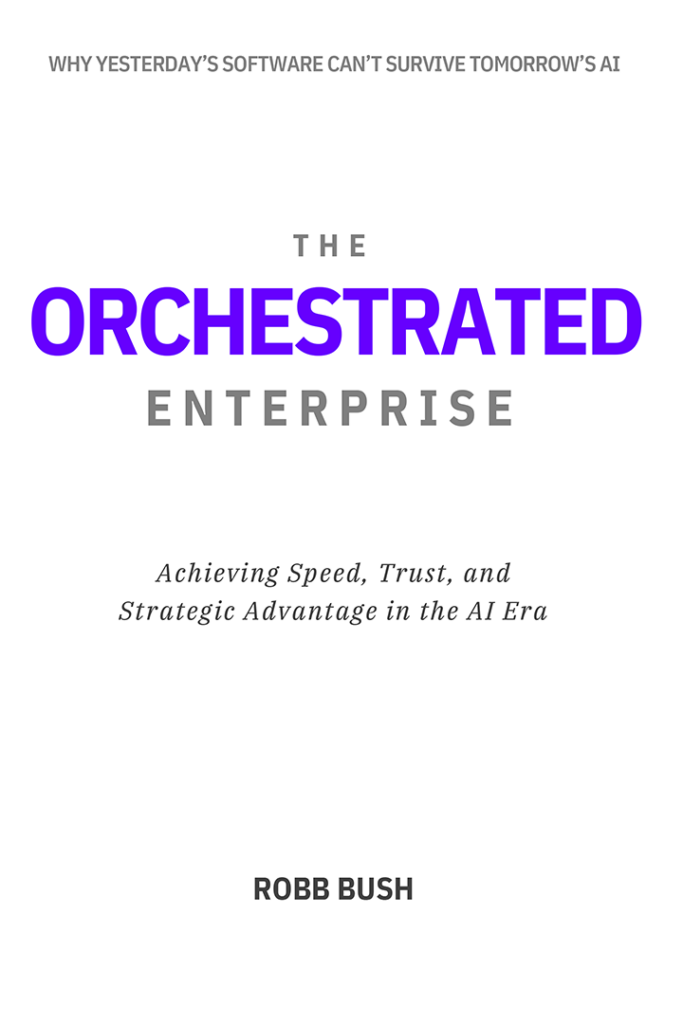
The Orchestrated
Enterprise
Achieving Speed, Trust, and Strategic Advantage in the AI Era
What happens when smarter tools give the enterprise more decisions to reconcile? Robb Bush examines the coordination problem and the operating architecture it calls for.
Explore the bookA clearer view
of what comes next.
All insights Put governance where decisions happen
Human authority is part of the architecture.
A space to think before the system acts
Why simulation belongs close to a consequential decision.
Coordination is an operating capability
Why connecting decisions matters as much as improving them.
LET’S TALK
What could work better?
A stubborn problem. A promising idea. Start wherever you are.